
Finding Salem Resident Records
A Salem residents directory is a set of narrow records, not one master roll. Begin with the fact that matches the question. A current Marion County address leads to the Assessor and GIS. A recorded transfer leads to the Marion County Clerk. An old household leads to directories, maps, newspapers, and archival finding aids. Court, voter, credential, and business systems have their own purposes and limits. Keeping the record type distinct makes a Salem search more accurate and stops a partial result from being treated as a full personal history.
First confirm the address and county. Salem extends across the Willamette River into Polk County, so a Salem postal address is not automatically a Marion County parcel. Keep directional suffixes such as NE and SE exactly as printed. Then retain the account number, legal description, publication year, or case number that the source provides. Those identifiers make a later request much more useful than a broad name-only request.
- Use the City limits locator to establish the municipal point and the responsible county.
- For a Marion County parcel, consult the Assessor record and note the account or tax-lot reference.
- Use GIS only to compare parcel context, streets, and available layers, then carry the legal description to the Clerk.
- For a past household, compare a dated directory, map, or newspaper with the deed and parcel trail.
- When a needed item is not online, request the exact record, date span, and identifier from its custodian.
Salem Resident Records Offices
Salem is both the Marion County seat and Oregon's capital, so County and State research offices sit close together but do not hold the same records. The Clerk keeps recording and archive routes. The Assessor maintains the county property layer. Marion County Elections administers local registration questions, while Oregon's voter tool is a separate state interface. The State Archives supplies historical series and older vital-record pathways. Start with the office that owns the record rather than asking one office to assemble material held elsewhere.
Marion County Clerk
Licensing and Recording
555 Court Street NE, Suite 2130
503-588-5225
Marion County Assessor
Property and assessment layer
Marion County addresses only
Use the current county contact route
Marion County Elections
555 Court Street NE, Suite 2130
Salem, OR 97301
503-588-5041
Salem's Two County Boundary
Salem's boundary crossing is a practical records rule. The City limits locator answers whether a point is in Salem. The appropriate county Assessor and Clerk answer parcel and recording questions. USPS answers the postal routing question. A result from one system cannot settle the others. West Salem is the clearest example: it can be within the City while requiring Polk County research rather than a Marion County search.
The distinction also protects historical work. A City permit, a county deed, a ZIP label, and a Census geography can overlap without describing the same jurisdiction. Save the exact street suffix, unit information, and source date before moving from one keeper to another. That simple discipline prevents a Salem record from being assigned to the wrong parcel or county.
Note: City boundaries, county jurisdiction, and postal delivery areas answer different questions, so each should be checked through its responsible agency.
Salem Parcel Record Limits
The Marion County Assessor Property Search is the official starting point for a Marion County address. The County describes its public property information as property description, ownership, tax-lot, district, mailing, location-address, and assessment detail. It says online data refreshes every 24 hours. Those fields help anchor a parcel, but an owner or mailing entry is not proof that a person currently occupies the address.
| Assessor field family | Use in Salem research |
|---|---|
| Ownership and mailing | Property-record attributes that require a date and source context. |
| Location address | Connects the account to the address form used by the County. |
| Tax lot and district | Useful identifiers for GIS and legal-description research. |
| Assessment detail | Assessment information, not a current household listing. |
The assessor interface was gated and dynamic during review, so no unverified field list is claimed. Use the live portal's visible controls and preserve the account reference it returns.
The County's assessment-search entry displays the official access route for Salem property research.
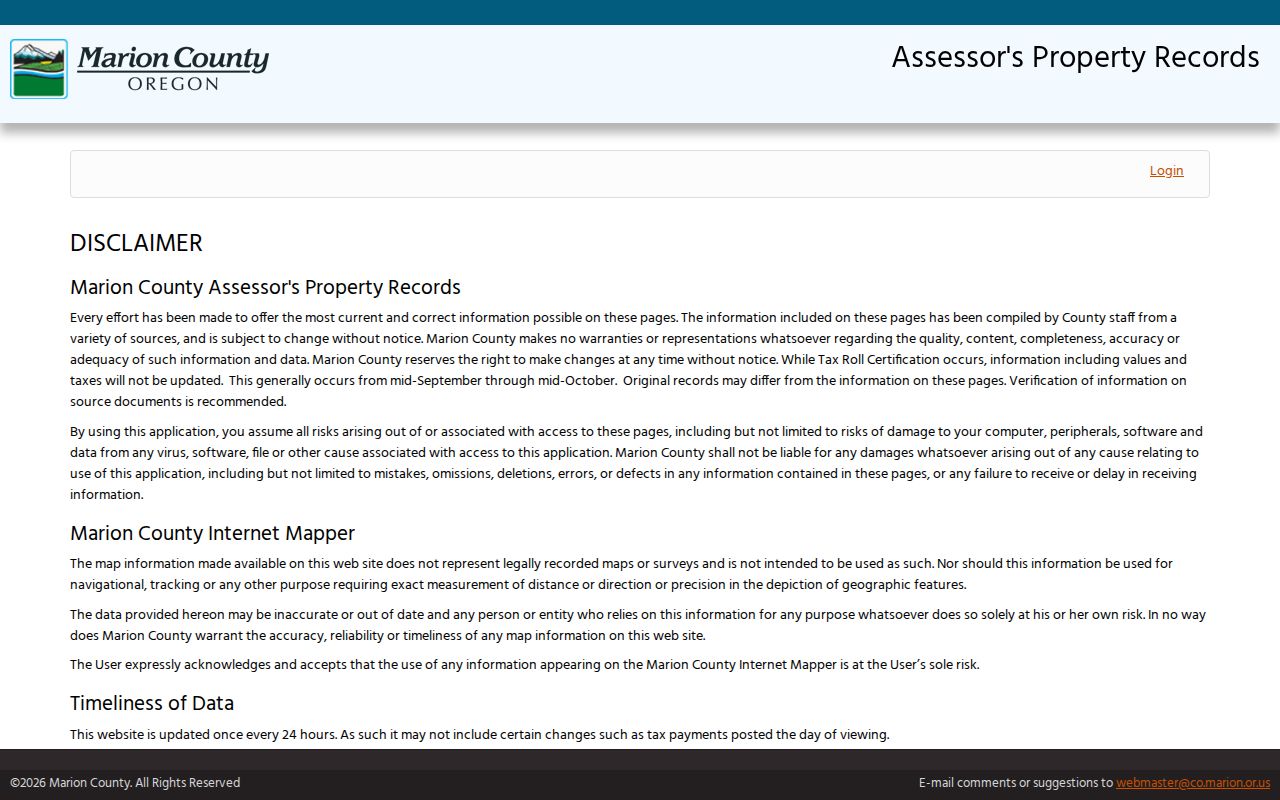
The access screen is useful as a reminder that a portal's current availability and acceptance steps can change.
Oregon Voter Records Near Salem
Election records have several separate uses. Oregon's individual voter-search entry point displayed a CAPTCHA during research, so its completed-query fields should not be guessed or bypassed. Marion County Elections provides the local administration route. Oregon Revised Statutes section 247.948 identifies categories of registration information that can be public, but excludes signatures, Social Security numbers, driver-license data, birth month and day, and other protected information. Ballot choice remains secret.
The State also publishes a voter-list request route, while Marion County makes aggregate registration reports available for 2012 through 2026. Those aggregate reports describe registration patterns by status, district, precinct, and household-level categories. They do not replace an official, permitted individual request or authorize a reader to infer political preference from a record.
The Oregon voter-search entry shows the verification barrier that applies before an individual lookup.
Use the official process for a permitted purpose, and leave protected information unavailable.
The State's voter-list request page is a separate route for data allowed by law.
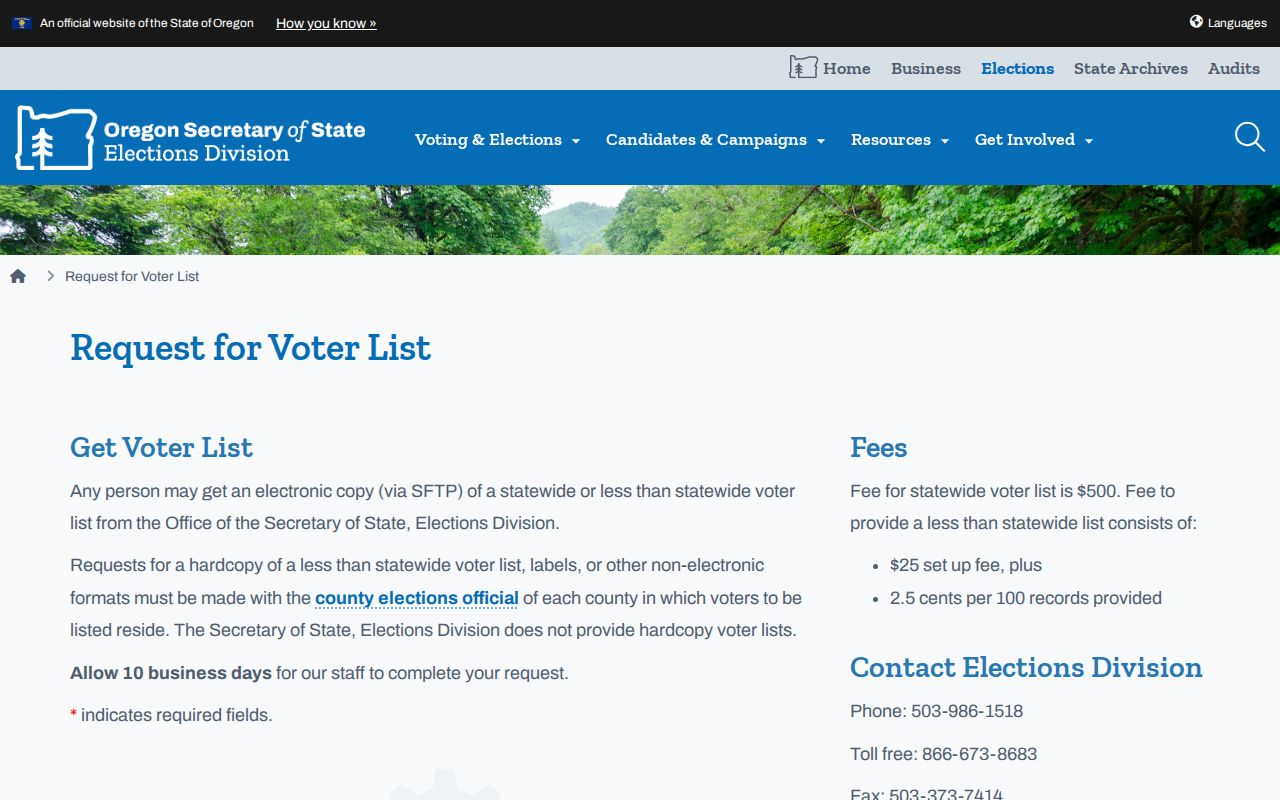
Fees, agreements, and access conditions can change, so the current state form is the authority.
Current Salem Resident Directories
Current Salem sources should be read by purpose. A property account identifies a parcel and its property-record fields. A recorded-document index identifies parties to a recording. An election resource follows election law. A business or credential tool verifies an entity or license, not a resident profile. None is a complete population list. For one person, compare an exact address, source date, and the agency's stated scope before treating records as related.
| Salem source | What it can establish | Custodian | Access path |
|---|---|---|---|
| Property account | Parcel, ownership, mailing, location, tax-lot, and assessment fields | Marion County Assessor | Current property portal |
| Recorded documents | Parties and document history connected to a legal description | Marion County Clerk | Digital route, historic route, or office |
| Registration data | Only categories permitted by Oregon law | Oregon Elections / County Elections | Official lookup or request process |
| Professional credential | Regulatory status and credential information | Oregon licensing board | Agency verification system |
| Neighborhood finder | Civic association geography, notices, and meetings | City of Salem | Address-based map finder |
A Salem records result becomes more useful when the question stays narrow. Use the address-focused Street Directory route for a parcel trail, not as a substitute for the correct custodian's record.
Salem Civic Map Context
Salem's address-based neighborhood-association finder adds civic geography to an address without creating a resident list. The City has recognized neighborhood associations since 1972 and currently identifies 17 of them. A map result can lead to an association's notices, agendas, minutes, meetings, and planning context. It does not establish title, membership, or a personal connection to a property.
This local layer can be useful beside a Salem Permit Application Center record. A PAC planning record can carry neighborhood context or attachments, while the association finder can identify the City-recognized area where public meeting material appears. Neither source establishes the condition of a building or who lives there. For a parcel question, return to the Assessor, GIS, and Clerk sequence.
Note: A neighborhood association describes civic geography around a Salem address, not a household roster or a property-interest record.
Salem Court Access Options
Court research starts with the court, not a name. The Oregon Judicial Department separates basic online records and calendars, courthouse public terminals, and the paid Oregon Judicial Case Information Network. The basic pathway does not include every matter. Adoption, juvenile, mental-health, and other protected categories can be excluded. An empty result does not settle whether a record exists, and a result line is not the complete file or a final disposition.
Marion County Circuit Court has six public terminals in its records lobby and describes digital or physical court records from 1987 forward, limited microfilm for 1910 through 1986, and limited audio beginning in 2001. Its request form asks for contact information, the case or party, approximate filing date, case number if known, and the document sought. A focused request respects staff time and produces a better search than a broad personal-history request.
The Oregon Judicial Department guide explains the available public search lanes.
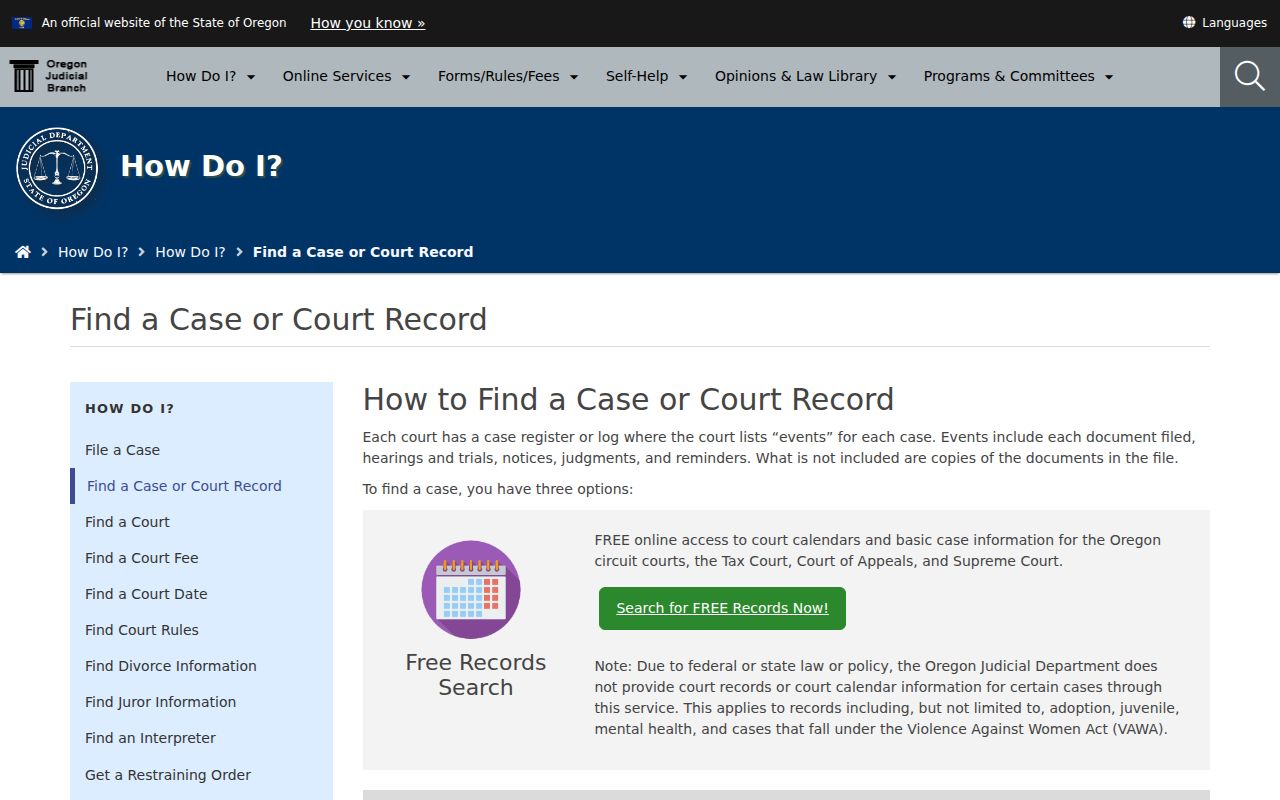
The court's online, terminal, and subscription choices have different depth and access limits.
Salem Credential Record Checks
Use an agency-owned lookup when the question is about a regulated credential or registered business. Oregon Medical Board verification supports name and credential-number searches, plus a specialty route using a city or five-digit ZIP and distance. A result can show credential number, status, dates, type, practice location, and Board-action links where applicable. That information answers a licensing question, not a question about a person's home.
Oregon's business registry accepts a business name or registry number, with advanced search available. The result can identify a registry number, entity type, registry date, registered agent, mailing address, and associated names. Filing contacts should remain filing contacts. They do not prove a storefront, current local activity, or a person's residence.
| Official source | General commercial profile |
|---|---|
| States its agency purpose, current scope, and record field. | May combine sources with unknown freshness or matching logic. |
| Lets a researcher retain the agency URL, identifier, and retrieval date. | Should be treated as an unconfirmed lead until the official custodian verifies it. |
For either source, keep the underlying record type visible rather than turning a credential or entity filing into a general identity conclusion.
Salem Deed Index Paths
Marion County's record map is especially useful for a Salem address history. The Clerk lists recorded documents from 1974 forward, historic deeds from 1855 through 1976, marriage licenses from 1849 through 1977, Commissioner Court Journal volumes from 1851 through 1984, and Board archives from 2013 forward. The recorded and historic-deed paths overlap, but they are not promised to provide the same interface, image, or index fields.
A legal description makes the connection between the Assessor account and the Clerk's document index. It may be a subdivision lot and block, a metes-and-bounds description, a section-township-range description, a partition plat, or an earlier book and page reference. A street address alone can miss that vocabulary. The Clerk allows public in-office searching and viewing without a search charge; its posted page lists copies at 25 cents per page and $3.75 search and certification charges. An image is not a certified copy.
The Digital Research Room begins with a disclaimer before document research.
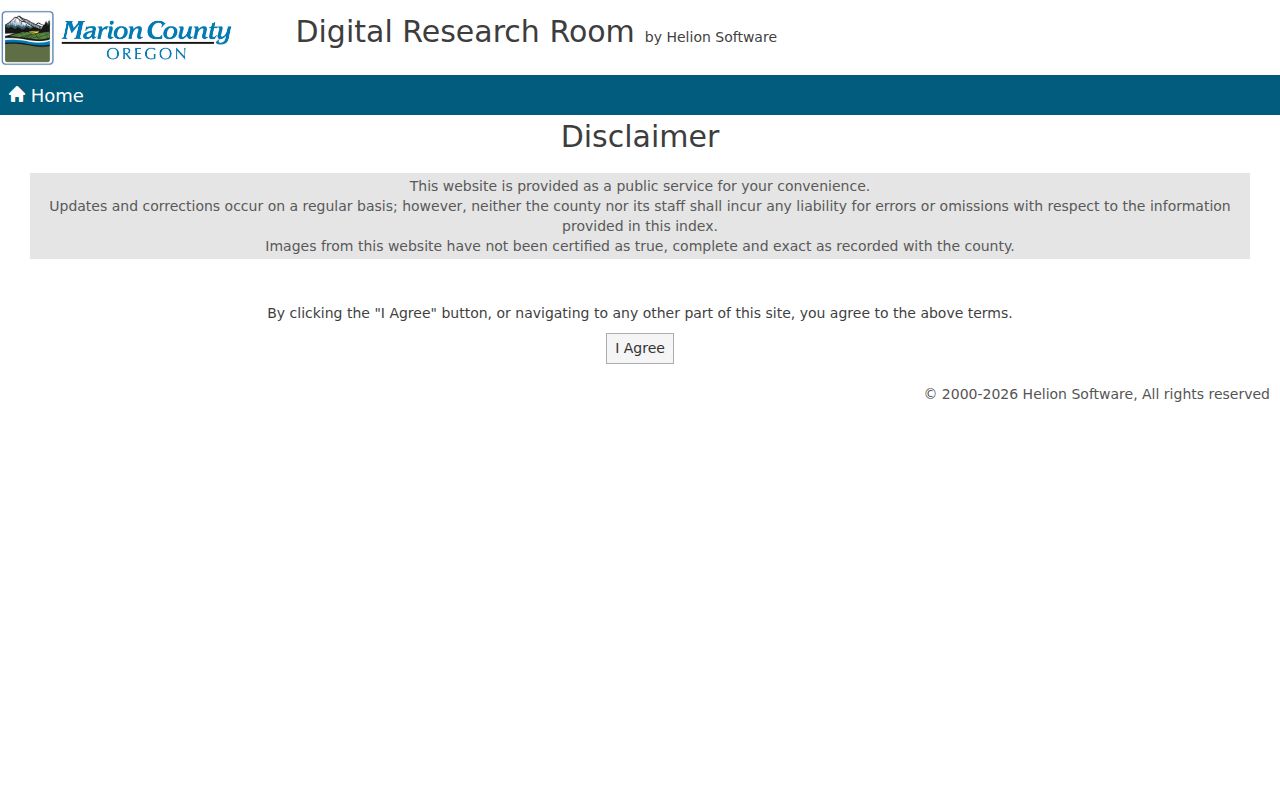
That acceptance screen is a useful reminder to distinguish an available record image from a certified record.
Historical Salem Resident Directories
Historical Salem residents directory work is time-specific. The City historic-property method begins with an addition name and lot or block, then follows ownership and maps. Salem Public Library provides routes to historical newspapers, maps, genealogy resources, and Sanborn maps, with access conditions that can include a library card or in-library use. Willamette Heritage Center preserves a digitized 1871 Salem City Directory, an 1892 map, local organization rolls, and early newspaper material.
A directory listing can show that someone was listed at an address in a particular publication year. It is not present identity proof. The City says address-to-person research gains a reverse index beginning in 1932. Before that, a researcher needs a name and searches forward. The historical collections themselves are described in the Salem City Directory section of the directory.
Salem's 1932 Directory Pivot
The 1932 reverse-directory threshold is one of Salem's most useful local research facts. A later address can be approached from the street, then compared with the directory and other dated evidence. Before 1932, the same task needs a person name obtained from a deed, map, newspaper, or other source. This is why an old address should not be forced into a modern search format.
- Parcel
- A county property unit used to connect an address, account, tax lot, and related records.
- Index
- A finding tool that points to records. It is not always the underlying image or certified copy.
- Criss-cross directory
- An address-oriented directory that can connect a published address to a dated listing.
- Legal description
- The recorded land description used to connect parcel research with deeds and other instruments.
Note: Retain the directory title, year, page, spelling, and abbreviation, because each can matter when similarly named people appear in Salem records.
Salem Vital Record Timing
Vital records use a different access rule than property or directory records. Oregon Health Authority eligibility rules generally set a 100-year public period for birth records and a 50-year period for other vital records. Qualified requesters must meet the relationship or authorization requirement and identify themselves. Oregon State Archives is the route for older open material, while OHA controls records still inside the restriction period.
At the beginning of 2026, the Archives announced the opening of 1925 birth certificates and 1975 death, marriage, and divorce material. That is a year-based update, not a promise that all Salem vital records are open. For an event inside the controlled period, use the current OHA eligibility and permission instructions rather than an ordinary name search.
The OHA birth-certificate ordering path presents the current certificate route and eligibility context.
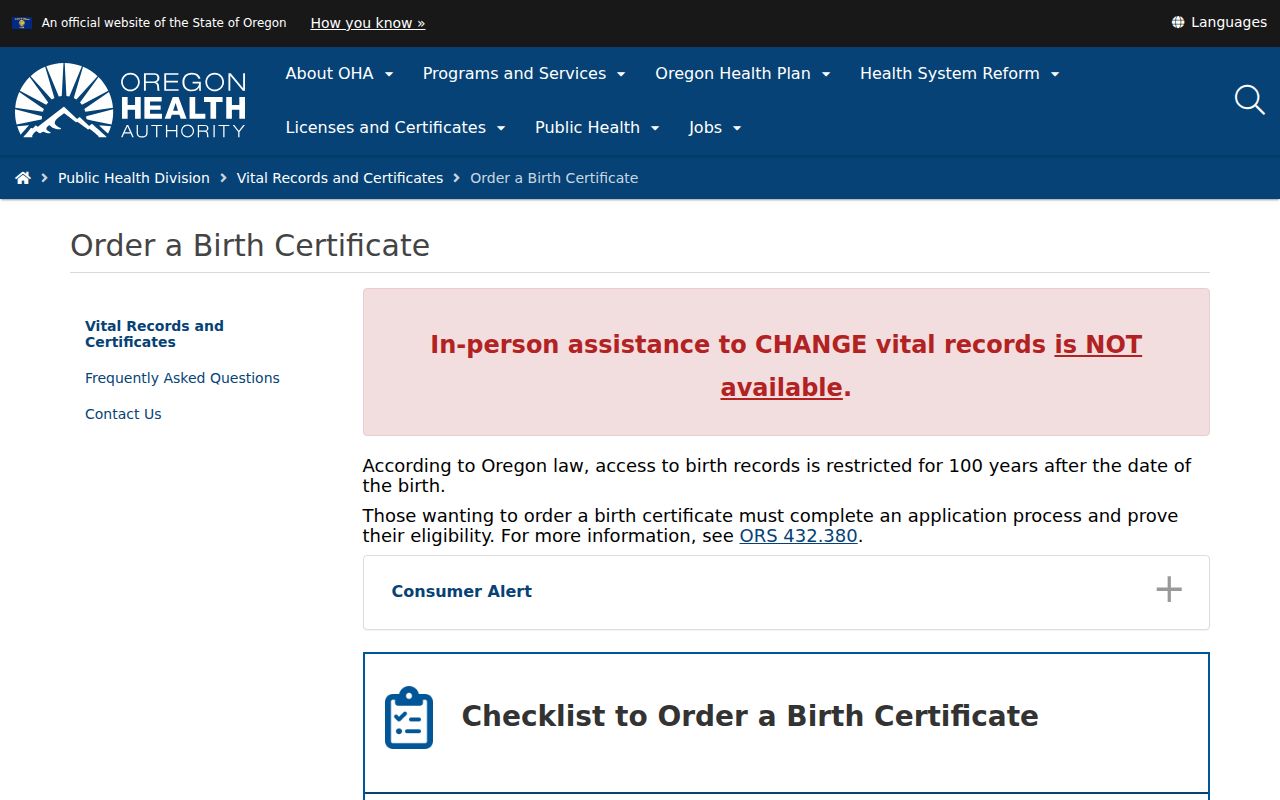
Use the agency's current instructions for record type, eligibility, identification, and ordering method.
Salem Privacy Record Boundaries
Oregon public-record access does not erase privacy protections. The Address Confidentiality Program gives eligible participants a substitute mailing address and mail-forwarding service. Protected locations should be left unavailable, not reconstructed from other records. ORS 192.368 provides a safety-related non-disclosure path for certain home address, telephone, and email information, subject to its stated limits. Court sealing, vital-record eligibility, and voter protections operate separately.
Lawful personal research only. Source records should be used for family history, civic questions, an estate matter, or another lawful purpose. Do not use any result to stalk, harass, or harm another person.
For a focused public-record request under Oregon Revised Statutes, Chapter 192, name the agency, record type, date range, address, case, or parcel identifier, and preferred electronic format. Agencies generally acknowledge or respond within five business days and provide a completion or progress response within ten business days after acknowledgment. They may still redact, withhold, or explain that the record is unavailable.